Re-Entry.mp3
Greek Amphitheatre
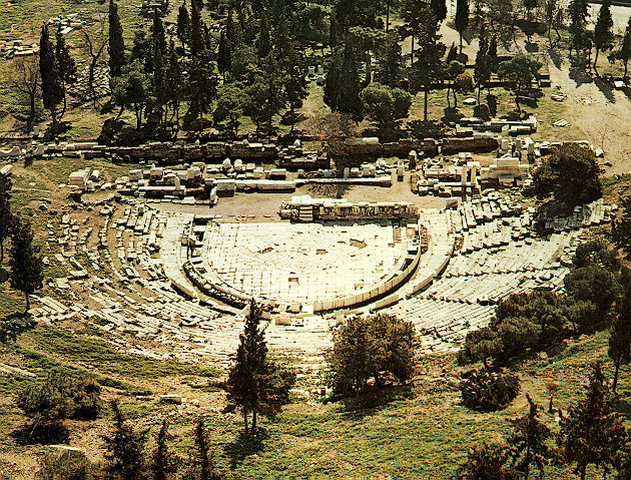
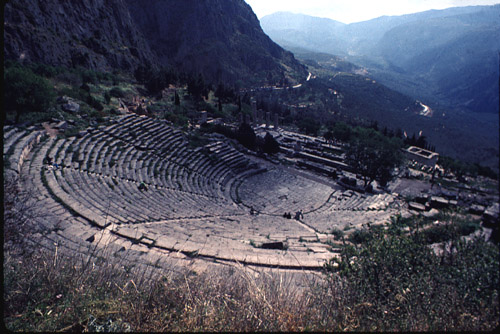
Since most of Greek Theatre was performed at religious festivals it was important to have a large space to perform in. The word amphitheatre comes from the ancient Greek word ‘amphi’ meaning ‘around’ or ‘on both sides’, and the Greek word ‘théātron’ meaning ‘place for viewing’. A typical Greek amphitheatre would hold anywhere from 14,000 to 17,000 people. Amphitheatre’s were large, open-aired structures often terraced into the sides of hills. Since most events and drama of the time were performed during religious festivals and ceremonies the amphitheatres would be located close to temples.
The Science Behind the Theatre
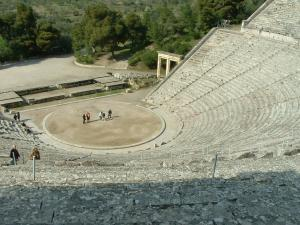
In a world without modern technology the amphitheatre truly was an amazing structure capable of projecting the natural voice to the very back of the theatre. The ability to create such a perfect acoustic filter comes from the limestone they would use in the seats. The Theater at Epidaurus is a prime example of the perfect amphitheatre.
Parts of the Amphitheatre
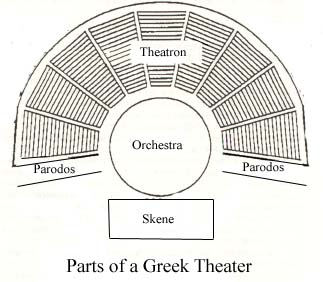
The main performing space of the amphitheatre was the orchestra or “the dancing place”. The audience would sit in the theatron or “the seeing place” on semi-circled terraced benches. On the far side of the orchestra would be the skene, meaning “tent”. Here the actors would store masks and costumes and perform quick changes. On either side of the skene would be the eisodoi and parodoi, long ramps which would lead to or from the orchestra.