Re-Entry.mp3
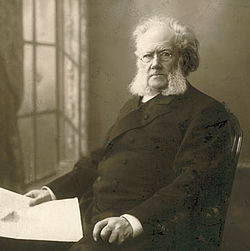
The Father of Modern Realism
1828 – 1904
Probably the Most Influential Figure in Modern Theatre
Ibsen saw drama as means for Social Change. He wrote at a time of changing ideas and beliefs and wrote his ideas in the plays. People came away questioning their beliefs. No one did that since Sophocles in Greek times. The strength of his play is in setting the middle class on stage. Ibsen looked out for society in his works.
Turned the Theatre Stage into a Mirror
People saw themselves in the characters. They also saw their clothes, their houses, and their lifestyles. These plays were the first to examine real people as tragic characters. Ibsen showed that tragedy could be written about ordinary people speaking ordinary language. He also showed the individual in conflict with society.
Ibsen said, “My task has been the portrayal of human beings.” He looked at a character outward and inward. This approach makes him universal and timeless. Through his characters, we see the revolution of truth, what really goes on in the mind. “Before I write one word, I must know the character through and through… Then I don’t let him go.”
His Life
Four stages of Ibsen’s life:
1. Early years of failure: Ibsen assisted in an apothecary, went to university, left for a job in theatre but he wasn’t accepted. He was an alcoholic who could be found nightly in the gutter.
2. Wrote dramas from 1860s to 1870s: When Ibsen was 36 years old, he got a small pension and left for Italy in “self exile”. He had more success there.
3. Socialitical Plays: Ibsen wrote his most famous plays during this time. The three most popular ones are A Doll’s House, Ghosts, and Enemy of the People.
4. Contemporaries: These plays were more internal works.
The last 15 years of his life were spent back in Norway. In 1899, Ibsen wrote his last play, which was 50 years after his first play.
At the turn of the century, he was the most popular of playwrights. His success is equivalent to if an Eskimo revolutionized theatre today.
His Works and their Criticism
A Doll’s House (1879): It was banned in Norway. A Doll’s House is the most influential of all his plays. After audiences saw this, men couldn’t expect their wives to regard them as Gods anymore. Women saw that they could think for themselves.
Ghosts (1881): In 1891, the London Daily Telegraph called Ghosts “positively abominable… Ghosts, without a single vulgar word, exposed the horrible implications of a hypocritical Victorian marriage whose result is venereal disease resulting in ‘mercy killing’.”
Ibsen’s plays had critics. There were even some who accused him of using the well made play formula to merely shock the audience.