Re-Entry.mp3
CHRISTOPHER MARLOWE
The Early Years
Christopher Marlowe was baptized in Canterbury on February 26, 1564; just barely two months before his contemporary William Shakespeare would be born. He was the son of John Marlowe, a shoemaker, and his wife Katherine. Not a lot is known about his early years, he attended The King’s School in Canterbury and then the Corpus Christi College in Cambridge where he received his Bachelor of Arts in 1584. He continued at the university but in 1587 they hesitated to give him his master’s due to a rumor that he had converted to the Roman Catholic Church and intended to go to the English college in Rheims, France to prepare to take the priesthood. He was awarded his master’s when the Queen’s Privy Council (a council consisting of senior members of the government, military leaders, judges among others) sent a letter on his behalf. Attached to the letter were some pretty powerful names including the Lord Archbishop, the Lord Chancelor, the Lord Treasurer, and the Lord Chamberlaine.
"Whereas it was reported that Christopher Morley was determined to have gone beyond the seas to Reames and there to remaine, Their Lordships thought good to certefie that he had no such intent, but that in all his accions he had behaved him selfe orderlie and discreetlie wherebie he had done her Majestie good service, & deserved to be rewarded for his fathfull dealinge: Their Lordships request that the rumor thereof should be allaied by all possible meanes, and that he should be furthered in the degree he was to take this next Commencement: Because it was not her Majesties pleasure that anie one emploied as he had been in matters touching the benefitt of his Countrie should be defamed by those that are ignorant in th'affaires he went about."
Dramatist and Poet
The extent of Marlowe’s literary career is six plays, two poems, and two translations and only one of his plays would ever be published while he was alive and yet in the seven years in which he was writing (1586-1593) he quickly became one of, if not, the foremost playwright in England at the time. His works showed a mastery of blank verse, dealt with controversial themes, and inspired many of his other contemporaries, including William Shakespeare.
Plays:
Dido, Queen of Carthage
Edward the Second or The Troublesome Reign and Lamentable Death of Edward the Second, King of England, with the Tragical Fall of Proud Mortimer
The Jew of Malta
The Massacre at Paris
Tamburlaine the Great, Part I
Tamburlaine the Great, Part II
The Tragicall History of the Life and Death of Doctor Faustus
Poems:
Hero and Leander
The Passionate Shepherd to His Love
Translations:
Lucan’s Pharsalia
Ovid’s Amores
A Mysterious Death
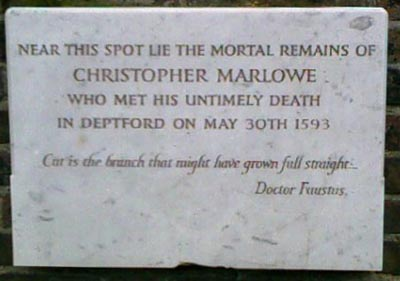
Marlowe died on May 30, 1593 in Deptford, England at the age of 29. A lot of mystery and speculation surround the details of Marlowe’s death. A warrant was issued for Marlowe’s arrest on the 18th of May by the Privy Council on reports of heresy, Marlowe reported himself on the 20th but a trial was indefinitely postponed, ten days later Marlowe was dead. One report from Francis Meres in his book Palladis Tarnia, claims that Marlowe, in punishment for his “epicurism and atheism” was “stabbed to death by a bawdy serving-man, a rival of his in his lewd love”. Other reports claim that it happened during a bar fight, an argument over who would pay the bill, or even an assassination. The three men he was with at the time, Ingram Frizer, Nicholas Skeres, and Robert Poley were all connected with the government in some form.
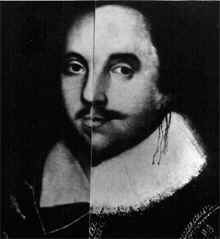
Another prominent theory behind Marlowe’s death is that of the Marlovian Theory. The theory claims that Marlowe did not die, rather his death was faked and he is in fact William Shakespeare. The evidence behind this theory is a similarity in writing styles and the fact that Shakespeare’s works didn’t gain prominence until after Marlowe’s death.
Whatever the case may be, the literary world definitely lost something with the death of Christopher Marlowe. To look back at what he achieved in just 29 years can only make us wonder what might have happened had he lived longer. Maybe today we would be studying Marlowe instead of Shakespeare. There is a line from Doctor Faustus on a plaque by Marlowe’s grave that sums the point up nicely, “Cut is the branch that might have grown full straight.”