Re-Entry.mp3
What is a pageant wagon?
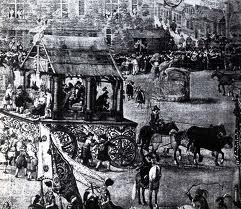
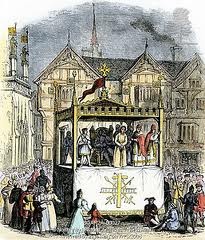
A pageant wagon is a wheeled vehicle used for staging plays. It was used from about 1375 until the middle of the 16th century. They were common in York, Chester, Spain, Belgium and the Netherlands. The pageant wagons usually performed religious plays also known as medieval vernacular cycle plays. Often when pageant wagons would perform they would join up with several other pageant wagons and each wagon would perform a part or a trilogy. Pageant wagons usually were popular during religious festivals, but they would travel throughout different locations hoping to sell their skills.
What did it look like?
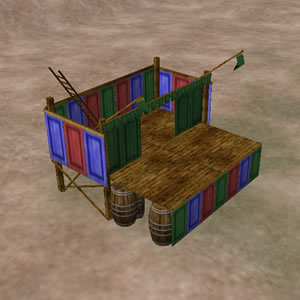
Very little information is known about what the pageant wagons looked like. There are currently two ideas of how the pageant wagons might have looked and functioned. The first idea is by Archdeacon Robert Rogers who, in 1595, is quoted as saying "pageants were a high scaffold with two rooms, a higher and a lower, upon four wheels. In the lower they appareled themselves, and in the higher room they played, being all open on the top, that all beholders might hear and see them." Meaning that it was a two floored stage the bottom floor was walled off and the actors would change costumes, while the top floor was open and allowed everyone to see and hear them.
This description might be accurate but it was written during a time that Pageant wagons might not have existed anymore. The opposition to the previous description was brought up by Glynne Wickham who argues that in The Early English Stages that the wagon was only a one level structure taken up entirely by off stage space used for a dressing room. This would provide the backdrop for the
Performance as well. The acting would then take place on a scaffold alongside the cart or on the street. This information is mostly based off of logic of the time and style of stationary theatres of the time.
Other information about Pageant wagons
No one really knows what the life of someone in a pageant wagon might be like but because of the history of how theatre was treated and the styles of entertainment during that time we can piece together what the life of a pageant wagon might have been like.
A good example of what a pageant wagon might do is from the play Hamlet. In this play Hamlet hires traveling actors to put on a play to his request. The actors agree and perform a play that their employer requested. The play of hamlet if fictional so there is no way of knowing if the players hamlet hired are an good description of what traveling actors might encounter. If this peace of text is slightly accurate it is possible that Traveling actors much like actors in a pageant wagon would take requests of plays or styles of plays and improvise the majority of the play.