Re-Entry.mp3
REALISM
The Advent of Realism
While the industrial revolution brought many technological advances it also brought many social changes as well. In Europe with the increased populations in cities living conditions oftentimes became worse and disease such as tuberculosis took many lives. Romanticism was seen as a means of escape from the confines of the time; likewise in the second half of the 19th century Realism became a polarized opposite to contrast Romanticism.
What is Realism?
“The theory or practice of fidelity in art and literature to nature or to real life and to accurate representation without idealization.” Merriam-Webster Dictionary
“Broadly speaking, the attempt to present onstage people and events corresponding to those observable in everyday life.” Living Theatre 5th Edition
“Realism, term applied to literary composition that aims at an interpretation of the actualities of any aspect of life, free from subjective prejudice, idealism, or romantic color.” Encyclopedia.com
The three definitions presented just barely scrape the surface of what people define as realism. Realism exists in many forms: there is political realism, scientific realism, philosophical realism as well as artistic realism. Ultimately they all strive to achieve the same goal: portraying life as it truly is while avoiding bias. With the ideals of realism playwrights were able to address many subjects that were previously considered taboo including unhappy marriages, social and economic injustices, sexual double standards and many others. Many realist playwrights thought the purpose of drama was to bring attention to such social problems in order to cause change.
Naturalism is an extreme form of realism which was extremely influenced by such theories of the time as Darwinism. Naturalism suggested that environment and social conditions play an inescapable part of everyday life.
Some Pioneers of Realism
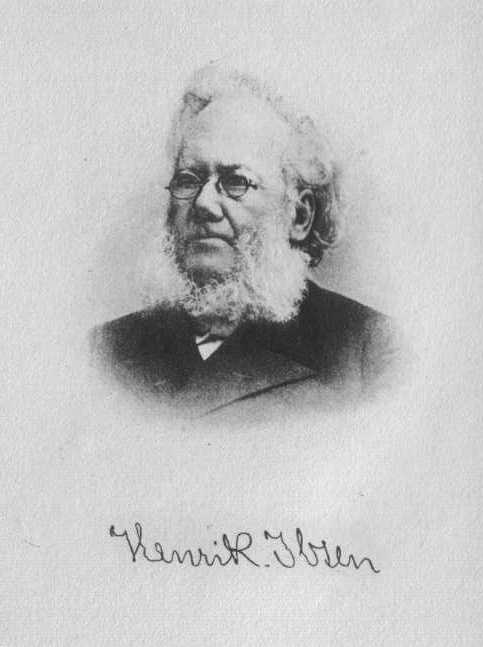
HENRIK IBSEN
· 1828-1906
· Norwegian playwright
· Considered the founder of modern realism
· Originally wrote romantic plays before moving into realism, later in his life he explored symbolism and mysticism
· Realistic Works: The Pillars of Society (1877), A Doll’s House (1879), Ghosts (1881), An Enemy of the People (1882), Hedda Gabler (1891)
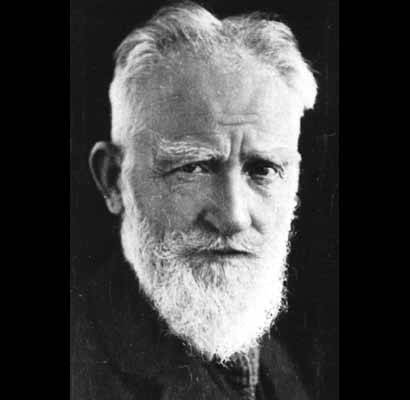
GEORGE BERNARD SHAW
· 1856-1950
· Born in Dublin, Ireland to English parents
· Plays characterized as realistic comedies of manner
· Realistic Works: Candida (1895), Caesar and Cleopatra (1899), Major Barbara (1905), Man and Superman (1903), Saint Joan (1923)
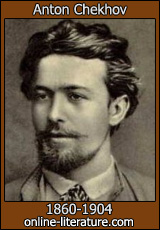
ANTON CHEKHOV
· 1860-1904
· Russian playwright
· Wrote realistic tragicomedies
· Realistic Works: The Seagull (1896), Uncle Vanya (1899), Three Sisters (1901), The Cherry Orchard (1904)
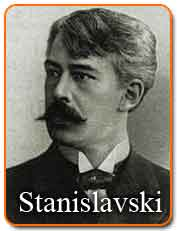
STANISLAVSKI
· 1863-1938
· Russian; cofounder of the Moscow Art Theatre, directed Chekhov’s major plays
· Developed the Stanislavski Technique of Acting focused on acting realistically on the stage
REALISM WORKSHOP
An acting workshop is being held by the one and only Konstantin Stanislavski. In this workshop we will learn some techniques and exercises that will help us act realistically on stage!
“All of our acts, even the simplest, which are so familiar to us in everyday life, become strained when we appear behind the footlights before a public of a thousand people. That is why it is necessary to correct ourselves and learn again how to walk, sit, or lie down. It is essential to reeducate ourselves to look and see, on the stage, to listen and to hear.”
Seven concepts to remember:
1) Relaxation
a. In order to truly portray a character effortlessly you must have complete freedom and relaxation.
2) Concentration and Observation
a. Circle of Attention: your extent or range of concentration
3) Importance of Specifics
a. In life we express emotions in terms of specifics whether through action or speech.
4) Inner Truth
a. Finding the characters thoughts and emotions and achieving an inner sense of truth in order to portray a character. The “magic if”.
5) What? Why? How?
a. All action on stage must have a purpose. What is the action? Why is it occurring? How is it occurring?
6) Through Line of a Role
a. What is the characters superobjective? What is the overall thing(objective) a character wants throughout the course of the play.
7) Ensemble
a. Remember that you can’t act with an army of one. Everyone must be united and present within a scene even when they don’t necessarily have an action or are speaking.
EXERCISES:
1) Group Focus. We’ll start off with this exercise so we can gain a better attention/ concentration to the work at hand and come together as an ensemble! Stand in a circle and count together as a group, paying attention to all the others so that only one person says each number. If two of you say the same number start back at the beginning. Try and make it to 20!
2) The “magic if”. Learn to move fluidly and for a purpose within a space. Decide upon a character and for each action or movement ask: What are you doing? Why are you doing it? And how are you doing it? To help you find the inner truth of the character. Next add some layers by incorporating some more given circumstances. Pretend you are packing to go on vacation: how does this change your actions? Or maybe you are preparing to go to war: how does that effect everything you do?
These may seem like very simple things to do and achieve, but in truth they are the foundations for most acting methods found today. They have to be applied and done with everything you do so you can develop the muscle memory that it will eventually come naturally to you.
MOST IMPORTANTLY HAVE FUN!